
Choosing the Right Protection: A Guide to Type 5 & 6 Fabrics
PROTECTIVE APPAREL
InnoviSafe
12/16/20252 min read
In the world of industrial safety, the terminology can often feel like alphabet soup. When you see "CE Type 5" or "Type 6" on a coverall label, you aren't just looking at a rating—you’re looking at a specific engineering choice in fabric technology.
Understanding the materials behind these suits is the difference between staying protected and being exposed to hazardous chemicals or particles. Here is a summary of the three primary fabrics used in Type 5 and Type 6 protective clothing.
The Ratings: A Quick Refresher
Before diving into the fabrics, let's define what we are protecting against:
Type 5 (EN ISO 13982-1): Protection against hazardous dry particles (solid dusts).
Type 6 (EN 13034): Protection against light liquid sprays and splashes.
Most modern disposable coveralls are dual-rated as Type 5/6, meaning the fabric must be versatile enough to block both fine dust and liquid mists.
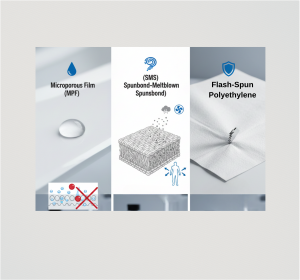
1. Microporous Film (MPF)
The Best All-Rounder for Liquids.
Microporous Film is a "laminated" fabric. It consists of a tough spunbond polypropylene base bonded to a specialized polyethylene film. This film contains millions of tiny pores that are too small for liquid droplets to pass through, yet large enough to allow water vapor (sweat) to escape.
Best for: Tasks involving liquid chemical splashes or biological hazards.
Key Advantage: It offers the highest liquid repellency of the three and is virtually lint-free, making it ideal for paint booths or cleanrooms.
Trade-off: Because the film is a solid layer, it can feel warmer than SMS during high-intensity labor.
2. SMS (Spunbond-Meltblown-Spunbond)
The Champion of Breathability.
SMS is a three-layer "sandwich." The outer layers provide structural strength, while the middle "Meltblown" layer acts as a sophisticated filter. Think of it like a high-grade furnace filter for your body.
Best for: High-temperature environments where dry dust (Type 5) is the primary concern.
Key Advantage: Incredible breathability. It allows maximum airflow, significantly reducing the risk of heat stress for the wearer.
Trade-off: It is less effective against liquids with low surface tension (like oils), which can sometimes "wick" through the fiber matrix.
3. Flash-Spun Polyethylene (e.g., Tyvek®)
The Durability Leader.
Unique among the three, flash-spun polyethylene is a non-layered, monolithic material. It is created by spinning continuous high-density fibers that are then heat-bonded together.
Best for: Rugged environments where the suit might snag or scrape.
Key Advantage: Inherent protection. Because it isn't a laminate or a sandwich, the barrier exists throughout the entire thickness of the fabric. If the surface gets scratched, the protection remains.
Trade-off: It offers a middle ground in breathability—better than MPF, but not as airy as SMS.
Comparison Summary
Fabric Type. Particle Protection. Liquid Protection. Breathability. Durability
MPF Excellent Excellent Low/Moderate Moderate
SMS Good Basic High Moderate
Flash-Spun Excellent Good/Very Good Moderate High
Which Should You Choose?
The "best" fabric depends entirely on your environment:
Facing chemical splashes? Choose Microporous Film.
Working in a hot, dusty warehouse? Go with SMS.
Doing heavy-duty demolition or remediation? Reach for Flash-Spun Polyethylene.
By matching the fabric technology to the specific hazards of your job site, you ensure that your team stays not just compliant, but truly safe.
© 2026 All rights reserved.

Envisioning Tomorrow's Protection